Hi Anton! We are very happy to have you as part of our success stories. We are excited to learn more about silana. How and when did your journey begin?
The initial idea was to bring fashion design closer to the end customer. We wanted to build an online toolkit that would let customers design and order their ideal fashion item in 3D directly in the browser. This idea came from Michi Hofmannrichter, who had already been at icons before me. Michi Mayr joined the project before I did and had strong experience in the fashion industry through his family business.
Michi Hofmannrichter approached me at an icons summer event because of my tech and coding background and asked if I wanted to join. From then on, we worked on the project and tested many things to make the idea work. But it did not really perform the way we expected.
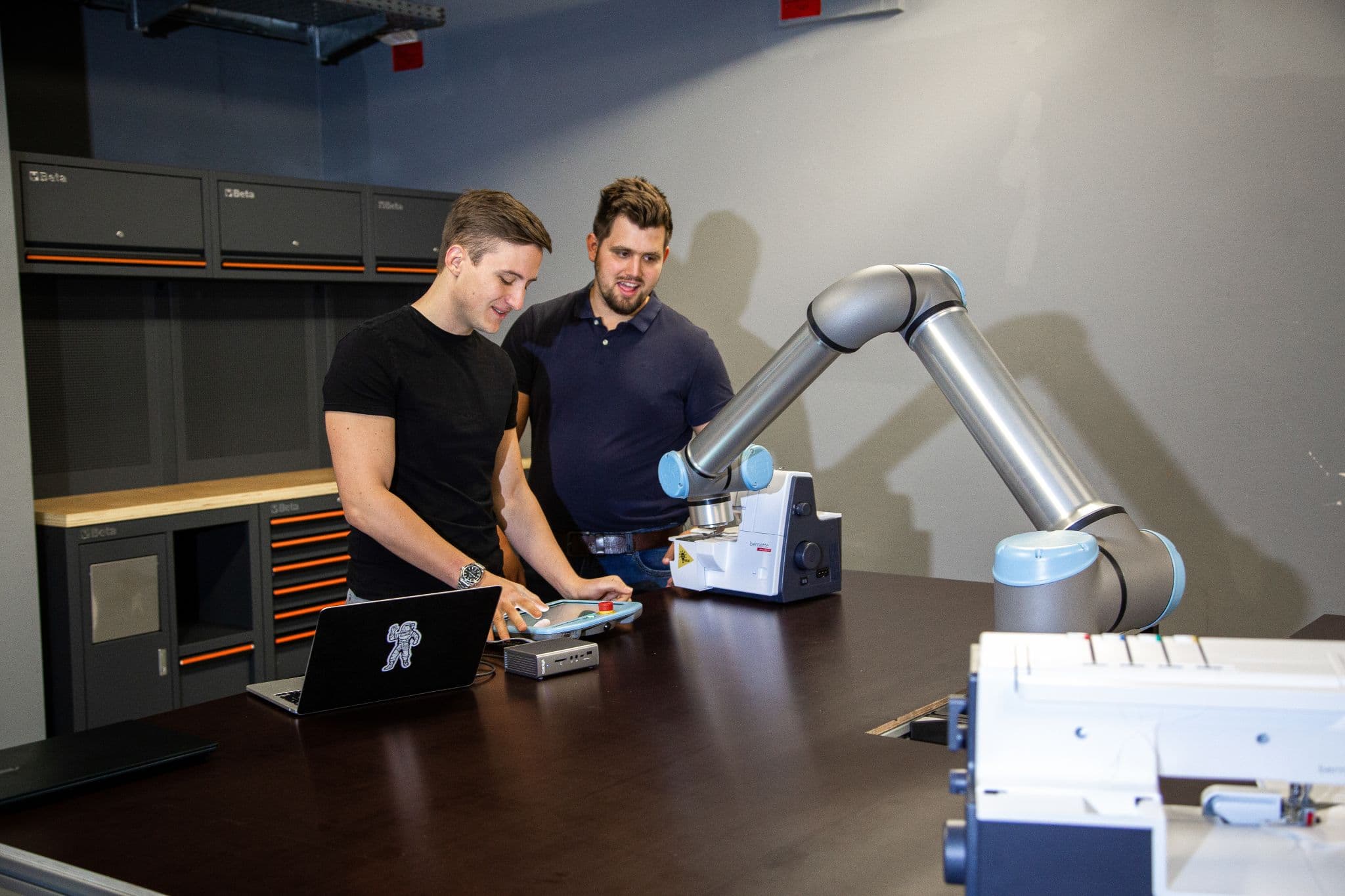
After one year, we had already immersed ourselves deeply in the fashion industry and asked what the real challenges were. We identified that it was almost impossible to manufacture cost-effectively in Europe. We wanted to solve that and came up with the idea of building a robot to produce textiles in Austria. That was the start of our silana journey.
So you had the idea and decided to work on it. What did implementation look like?
Once we moved away from our original idea and decided to build a robot, we shifted from a software start-up to a hardware start-up. That also means playing by completely different rules. Funding was one of our biggest challenges throughout. Hardware development is very capital-intensive, so in the last years we repeatedly bootstrapped: starting small, investing our own resources, securing grants, and moving forward step by step.
At the same time, a strong network in the tech industry was always critical. Through icons we had a clear advantage. We spoke to many experts, which is essential in hardware development. You have to stay in constant exchange with the market so that product and market fit really align.
Funding is a huge topic for start-ups. You mentioned grants. What has your financing experience at silana looked like?
As mentioned, we bootstrapped heavily in the beginning, and it took a full two years before we received our first grant. In February of last year we got our first approval, and from there things really accelerated. Since then we have raised around 500,000 EUR in capital, a large share of it through public funding.
What role did icons play for you from the initial idea to execution?
Many people who first get to know icons see it as a high-performance group focused only on careers. What they often miss is that close friendships form between smart, driven people. For our founding team, that friendship was extremely important. We had already worked together on several icons projects in a high-pace environment. You learn how to work efficiently, but also how to position yourself well.
icons played a very important role because we met there and built an incredible friendship. At the same time, icons gave us a platform. Through the After-DiMee culture, we could speak after weekly update meetings with alumni who had founded companies or taken less conventional career paths. That helps a team form around a big vision and around people who share similar dreams and may even have already achieved them. That is extremely motivating.
What has been your biggest challenge so far with silana?
On the one hand, there were the financial challenges I already mentioned. But there was another challenge we rarely talk about: we wanted to build a robot for a massive industry, where many others had failed before. As a result, our technological risk was far higher than our financial risk.
One final question: what is your advice to students with big ambitions?
At the end of each day and week, ask yourself: if I repeated the last 24 hours or seven days over and over, would I actually reach my goals? Would that be a life I want to live? This has helped me a lot, especially during university when you study hard for exams and neglect everything else. Without balance, you will not be happy in the long run.